Innovative Technology For Road Surface Stabilization
We make use of innovative enzyme-based technology to build and improve the base of paved and unpaved roadbeds. Engineering qualities of local soils are improved, with higher compaction densities, increased strength and reduced construction and maintenance costs.
Advantages of Enzyme Soil Stabilization Technology
Environmentally Friendly
100% natural, safe to use, non-toxic and non-flammable. No threat to human or animal health.
Sustainable
Minimum maintenance. Increased road life. No specialized equipment or labor.
Cost Effective
Meets budget requirements as both product and construction are highly cost effective.
High Quality & Performance
Enzyme stabilized surfaces show a significant increase in bearing capacity while maintaining dust free and water repellent for prolonged periods of time.
WE SERVICE
Public and Private Roads
Rural roads, secondary roads, road shoulders, parking areas and sports fields
Sub-Base Improvement
Improve Sub-Base strength for block paving and asphalt application
Construction and Commercial Projects
Construction projects, mining sites, airport runways, taxiways and haul roads
APPLICATION
The application of our enzyme technology will minimize or even eliminate the need to cut and spoil and import of suitable materials, adding up to notable extra expenses. At a fraction of the cost, in situ soils can now be treaded with TERRAZYME 11X on site, imporoving the existing materials to meet AASHTO requirements, showing increased compaction densities, reduced water permeability and limited loss of fines due to corrugation.
HOW IT WORKS:
During application the enzymes act upon the soil’s organic fines through a catalytic bonding process, promoting certain chemical physical and chemical reactions to produce a strong cementation effect. After optimum compaction is completed, the bonding process will sufficiently be cured within 72 hours. The enzymes lower the surface tension of the water. When mixed in the water cart on site it accelerates penetration and improves compaction with less effort. Up to 25% saving on requirement of compaction water have been documented.
HIGHLY ECONOMICAL:
Mixing is done on site and no extra equipment is required; no waste due to rapid setting times or weather conditions; fewer operating hours due to ease of application; saving in equipment expenses, fuel and water. Since TERRAZYME 11X interacts with a wide variety of soil materials, maximum use can be made of existing soils thus minimizes the need to haul additional materials at high cost.
LONGER LIFESPAN:
TERRAZYME 11X had been proven to prolong the lifecycle of the wearing course, reducing re-gravelling and maintenance costs.
EFFECTIVENESS:
The effectiveness of TERRAZYME 11X is influenced by the type of soil, its structure and it mineralogical composition.
APPLICATION STAGES
Loosen soil with Grader or Rotovator
Humidify soil using TerrZyme mixed with water
Mix treated soil to uniformity
Compact treated road surface near optimum humidity
Localized Businesses
Ask us about our Women Empowerment Program
Equipment Required
Tractor/grader with scarifying teeth
Tractor with Rotovator/disc
Water truck with separate water pump
Sheepsfoot compactor
Smooth/vibrator drum
Pneumatic roller
Local Based Labor
Successful Past Projects
Secondary Roads and Residential Developments:
- Joe Slovo Village Rustenburg/North West Provice Roads
- Royal Bafokeng North West Province
- Daveyton Ekurhuleni Metro
- Hammanskraal Tshwane Metro
- Grootfontein Estates Welbekend Private Developers
- Midstream Estates Midrand Gauteng Province PRV
- Construction Crossway Village
Port Elizabeth The Boatshed Developers - Finkelstein Development Windhoek
Namibia Roads Agency
Haul Roads:
- BHP Billiton Witbank Mpumalanga
- Sappi Baberton Mpumalanga
- Amplats – Steelpoort / Maandagshoek / Stilfontein / Amandelbult
- Impondo Mining – Mozambique / Zambia / Tantelite Resources
Madagaskar – Avantu sustainable solutions / Madagaskar Oil Company
Mafikeng / Intatakusa / R&H Railway Consultants - ZMC Mining Macuba Mozambique
- Namib Beton Windhoek
- Braamhoekdam WBHO
- Mogale Mines Krugersdorp/Rand
Game Parks / Private Resorts:
- Intaba Intle Game Private Resort – Bela Bela – Tim du Toit Developers
- Shonalanga Game Private Resort – Bela Bela
- Zebula Country Club and Spa Resort – Bela Bela
- Etosha Game Park Namibia
- Kruger National Park – Skukuza / Jakkalsbessie Camp – Vuswa Construction
- Limpopo Park, Mozambique
- Welgevonden Park Waterberg
North West Province
Provincial Roads:
- Bela Bela Roads Authorities
- Mokopane Leshika Consults
- Hogsback / Cathcart Eastern Cape
- Caledon / Hemel-En-Aarde Western Cape PD Naidoo
- KZN Roadprojects / WBHO / AG Agri Engineering Uvongo Cradle of Mankind – detour – Ruabex
- Saldanabaai West Coast PD Naidoo
- Overberg Southern Cape Martin & East
- Walvisbaai / Solitaire Namibia Roads Agency
Parking Areas:
- Rand Station (Soccerex) Bus parking area under grassblocks Tshepigo Consults
- Diamond Hill weigh bridge N4 – Basil Read
- Kievitskroon Estate Kameeldrift – Private development – Boutique Hotel & Events Resort
Road Shoulders:
- Rehabilitation of Road Shoulders – Old Pretoria Road Nelmapius / Mamelodi
- Roadex Construction Road shoulders R25 – Kaalfontein BKS
- Hans Strydom Road – Pretoria East – VKE / Patula Construction
Rural Roads:
- Hartebeestfontein Rustenburg North West Province
- Marken – Mosomo Construction / CSIR – Labor Intensive project Likasi
- DRC / Swanepoel Enterprizes Developments – Afri Group
Airstrips & Runways:
- Okavango Delta Botswana – Unidev / Wilderness Safari Group
- Sossusvlei – Namibia
- Wonderboom Airport – Tray for private aircraft
- Kruger National Park – Private camp airstrip
Sport & Recreation:
- Dreamfields Community Project – multipurpose sportsfields in rural areas asd for underprivileged children
- Walkways and Bicycle paths – Midstream and others
- Pathways for golfcarts
- Racetracks for Quad bikes & Scramblers
- Cricket Pitches – Flicx International / Lords at England / Ekhuruleni / various schools in Gauteng
- Hores Arenas – Housabout Lanseria
- Tenniscourts – Kutenga CC
HAULROADS, SAPPI BABERTON
Kruger national park
Wonderboom airport
Design roads for high strength and low cost with terrazyme
Structure strength = 100%
Construction cost = 100%
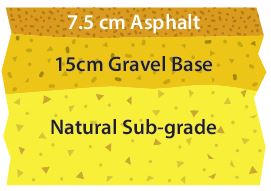
Structure strength = 100%
Construction cost = 80%
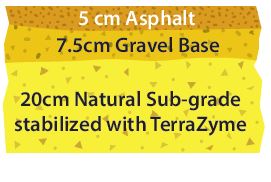
Structure strength = 100%
Construction cost = 60%
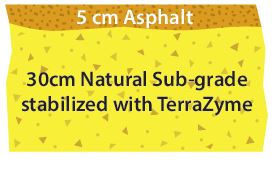
These three road models maintain the same AASHTO (American Association of State Highway and Transportation Officials) structure strength at dramatically different costs. TerraZyme improves low quality local soil and reduces imported materials and construction costs.
maintenance cost reductions untreated vs terrazyme
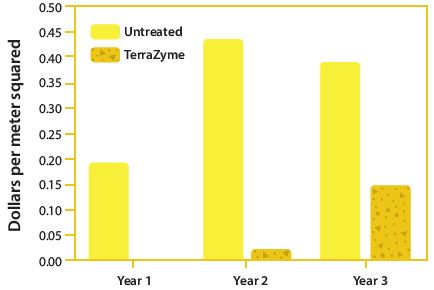
Terrazyme stabilization of plantation roads reduced road surface maintenance costs by 75% (Study results courtesy of PORIM)
road strength improvements after terrazyme stabilization
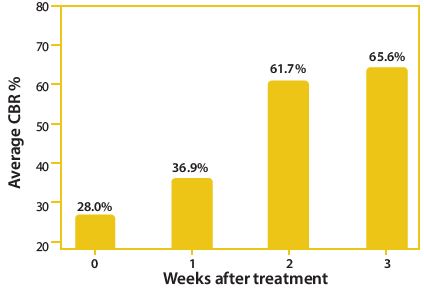
Lab study results from Brigham Young University, USA, show CBR% strength gains over time in soil stabilization with TerraZyme (actual field CBR% increases exceeded these values).
Frequently asked questions
WS14 is a biochemical soil stabiliser designed to improve the engineering properties of soil for road-base stabilisation. It enhances soil density, strength, and long-term durability through biochemical catalytic processes that improve particle bonding and reduce moisture sensitivity.
WSA14 is manufactured exclusively by WETCE Holdings (Pty) Ltd and supplied through authorised distributors. It is environmentally safe, non-toxic, and designed for sustainable road construction applications.
WSA14 works by modifying the interaction between soil particles through biochemical catalytic reactions. The treatment reduces voids, improves compaction, and forms a stable, water-resistant matrix within the soil structure. This results in improved density, reduced moisture sensitivity, and long-term structural stability.”
WSA14 is introduced into the compaction water prior to application. The treated water is then applied to the prepared base material using standard road construction equipment to ensure even distribution throughout the material.
The treated layer is mixed, shaped, and compacted using conventional construction methods in line with standard road-building practices.
WSA14 enhances the engineering performance of soil and gravel base layers by improving compaction efficiency and stabilisation during construction. When applied through compaction water, it promotes better particle interaction, resulting in a denser and more uniform base structure.
The treated material achieves improved load-bearing capacity, reduced permeability, and increased resistance to deformation under traffic loading. The result is a more stable and durable road base when constructed using standard road-building practices.
WSA14-treated gravel roads are maintained using standard road maintenance practices appropriate to stabilized base layers. Routine maintenance activities should be conducted with care to preserve the integrity of the treated surface.
In general, aggressive cutting or deep reshaping of the stabilized layer is not recommended without technical assessment, as it may affect the performance of the treated material. Light maintenance such as surface cleaning and drainage management can be carried out where required.
If significant deterioration occurs, maintenance intervention may include reworking of the affected layer, reconditioning of the material, and reapplication of stabilisation treatment according to project specifications.
Spillage material should be removed using appropriate non-destructive methods to avoid disturbing the stabilized surface.
WSA14-treated gravel roads can reduce dust generation by improving the cohesion and stability of the wearing surface. By enhancing particle bonding and compaction, the treated layer is less prone to surface breakdown compared to untreated gravel roads.
In applications where additional dust suppression is required, WSA14 may be used as part of a broader road treatment strategy in combination with suitable surface sealing methods, depending on project requirements and environmental conditions.
The economic feasibility of WSA14 is typically assessed through a life-cycle cost analysis based on project-specific conditions. By improving the stability of gravel wearing courses, WSA14 can contribute to reduced maintenance requirements and improved material retention over time.
In many applications, treated roads may require less frequent grading and reduced reliance on dust control measures compared to untreated gravel surfaces. Improved surface quality can also support more efficient vehicle movement, depending on site conditions and traffic loads.
Overall cost benefits vary from site to site and should be evaluated based on local material costs, maintenance practices, and operational requirements.